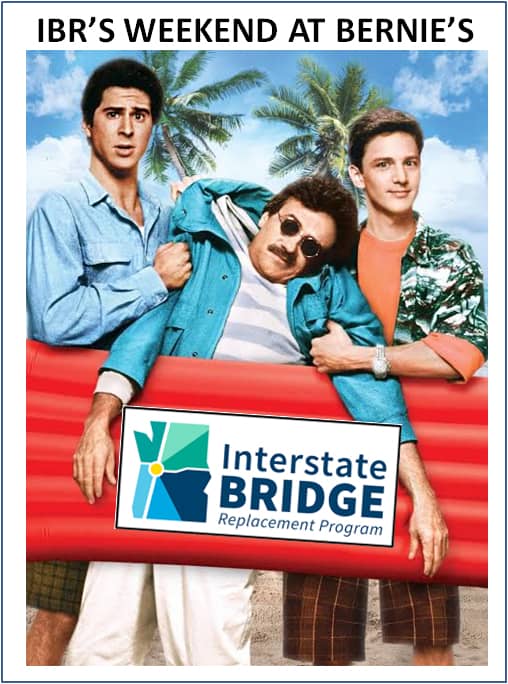
In what’s reminiscent of the 1989 comedy film “Weekend at Bernie’s,” we’ve known for months the IBR project was dying or dead, and yet the IBR continues to pretend it’s alive & well.
Here’s the post mortem:
- Price estimates for the project now range at unaffordable levels from $14 Billion to $17.7 billion.
- The successful NO TAX OREGON initiative indicates high voter opposition to more transportation taxes.
- The Vote Before Tolls initiative also indicates considerable support for voter controlled tolls.
- The IBR admitted that its bridge designs will not meet its primary goal of solving traffic congestion.
- The USCG denied permits for IBR’s fixed bridges, as IBR’s navigational clearance was less than 178ft.
- Without seismic proof, the IBR wanted to destroy our historic Interstate Bridge at a cost of $5 million.
- It crafted a false study to disqualify a less costly immersed tube tunnel (ITT) that’s more earthquake resilient.
- IBR’s 18,700 passengers/day estimate is now only 5,000/day, halting light rail expansion to Vancouver.
- The political winds have changed nationally, and IBR’s federal funding is now in question.
- The IBR lost credibility with legislators as it purposefully withheld cost estimates for months.
- IBR’s claim of full transparency was false, as it refused to publicly reveal bridge design heights & cost.
- Leaders of the IBR and ODOT are being replaced, most probably for mismanagement.
- The IBR failed to address Portland’s Critical Energy Infrastructure (CEI) hub earthquake concerns.
Multiple articles about the IBR are available in our Neighbors For A Better Crossing “News” Section
The IBR Project has been represented as a high quality engineering effort, but it wasn’t. Misrepresentations, errors, and miscalculations were common. IBR’s big mistake was to advocate an earlier Columbia River Crossing (CRC) approach that failed in 2014. We now learn the IBR based its new bridge designs on 20-year old CRC traffic data.
With all of its financial resources, the IBR failed to recognize early in their design process their bridge designs were inadequate to solve current traffic congestion at the crossing. With only 4-traffic lanes each direction, they failed to look upstream at Oregon’s I-205 Glenn L Jackson Memorial Bridge with its 4- traffic lanes each direction; it has daily traffic congestion each morning & evening. Before his departure, IBR’s Greg Johnson finally admitted the IBR’s bridge designs would not solve traffic congestion at the I-5 crossing, which was the IBR’s central reason for the IBR’s mega bridge.
According to traffic experts, in order for the IBR to solve traffic congestion with their mega bridge it would need a minimum of 5 or 6 lanes in each direction to compensate for merging traffic at the on/off ramps on Hayden Island. Those experts indicate the solution actually is to build an “expressway” for thru traffic (free of on/off ramps on Hayden Island) between Delta Park and Vancouver. This can be done at $$ billions less cost by retaining the historic Interstate Bridge for local access between Vancouver & Hayden Island, and having an immersed tube tunnel (ITT) between Hayden Island and Vancouver. The historic Interstate Bridge then becomes part of the solution, and the beauty of the bridge and the crossing is saved for generations to enjoy.
The ITT that’s being built at the Fraser River crossing to Vancouver, BC, has a river crossing very similar to ours. It’s a good example of an ITT for our crossing. What’s even more compelling is that an ITT is more earthquake resistant than a tall bridge, as it simply rests in a channel in the riverbed, rather than on tall bridge supports that can sway and break in an earthquake. An ITT also avoids the damage to marine life and the environment that IBR’s 250ft deep vibration drilling would cause in drilling its 99+ drillshafts (at $1 million each) over a 4-yr period, for its bridge supports.
IBR’s incompetence was on full display when they recently revised their original estimate of 18,700 passengers per day ridership down to 5,000 passengers per day for their light rail extension to Vancouver. That’s an 84% lower estimate than their initial projections, and a major error which is inexcusable for any engineering effort. With only 5,000 passengers/day instead of 18,700/day, there’s no financial support or justification for the high cost of extending light rail to Vancouver. A modest addition in TriMet bus service would easily accommodate that number of passengers per day.
To scare the general public into supporting its project, the IBR Program team in 2021 released a slick animated video showing the historic Interstate Bridge collapsing during an earthquake, without any seismic study to support such a claim. It was pure propaganda! The last seismic evaluation of the Interstate Bridge was a Columbia River Crossing study in 2006, which concluded it is feasible to retrofit the existing bridge to the current seismic safety standards.
The Interstate Bridge is a strong bridge that meets earthquake standards through periodic upgrades as mandated for all bridges. Its first span was open for traffic in 1917 with a second span added in 1958. According to the National Bridge Inventory (NBI) data as of 2025, there are 262 older road bridges in OR & WA. Oregon has 85 older road bridges built before 1917 and Washington has 177 such bridges, all of which are in daily use with years of service life remaining. It would be a tragedy to destroy any historic bridge before its time, especially when it can be key to solving traffic congestion at the crossing.
It’s time to recognize that the IBR project has become a “BRIDGE TOO FAR.” The project needs to be terminated with its funding repurposed either for an expressway with an ITT between Delta Park & Vancouver, or toward a 3rd crossing on the Columbia to mitigate Portland’s Critical Energy Infrastructure (CEI ) Hub earthquake concerns. The Columbia River Crossing (CRC) project cost taxpayers nearly $200 million before it failed, and now the IBR is spending another $300 million to repeat CRC’s failure. It’s time to stop wasting any more taxpayer money on a project that’s already dead.
Download Story: IBR’s Weekend at Bernie’s
Contact Info:
Gary Clark, Founder of Neighbors for a Better Crossing: gary@neighbors4a-bettercrossing.org or 503 703-9749 Kimberly Haslett, Volunteer for Neighbors for a Better Crossing: media@neighbors4a-bettercrossing.org or 503 720-4412