
The new estimate for the cost of the Interstate Bridge Replacement project has more than doubled to $13.6 billion. The cost is expected to range between $12.2 billion and $17.7 billion. The new estimate is 130% higher than the previous (2022) estimate. City Observatory obtained this estimate from previously unreleased documents it obtained via a public records request.
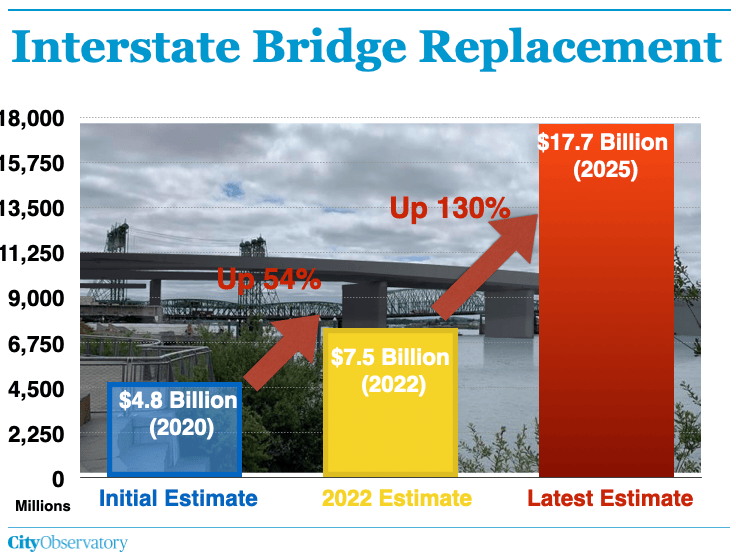
If IBR chooses to build a moveable span bridge because the Coast Guard will not vacate its earlier decision requiring a 178′ navigation clearance, the total cost of the project would be an estimated $14.6 billion, and could range as high as $19 billion.
IBR’s previous estimate, made in 2022, was that the project would cost about $6 billion (with a cost range from $5 to $7.5 billion).
Willamette Week
Interstate Bridge Staff Hid Information About Ballooning Cost of Giant Highway Project”
has a detailed story explaining the new estimate, and providing additional context.
We now know why IBR has delayed more than two years releasing new cost estimates–it is apparent that there is essentially no way Oregon and Washington could finance the bridge. The new cost estimates create a financial hole ranging from $5 billion to as much as $14 billion. This vast new liability likely dooms this project.
These huge cost increases come at a particularly bad time for Oregon and Washington: Oregon failed to pass a transportation package during the regular session of the 2025 Legislature, and the band-aid measure it enacted in a special session generated 200,000 signatures for referral, prompting Governor Tina Kotek to call for its repeal, which will lead to big ODOT budget cuts and layoffs. Meanwhile, Washington Governor Bob Ferguson is proposing issuing $3 billion in debt to finance an operation and maintenance backlog. Neither state has the needed billions to finance this project, as they scramble to maintain current services.
Along the way, IBR officials and consultants have billed close to $300 million for their work on a project which is now clearly not affordable. And new cost estimates have added a further $1.2 billion for staff and consultant work to the 2022 estimate, with these “non-construction” costs rising six times faster than construction costs.
IBR officials continued to keep rising project costs a secret, even as the Oregon and Washington legislatures wrestled with major transportation finance bill. IBR officials had these new estimates in hand, even as they testified to a bi-state committee overseeing the project in September and December of 2025.
IBR’s New Cost Estimate: From $7.5 billion to $17.7 Billion (or more)
City Observatory obtained documents on the cost estimate from a public records request. These documents have not been previously publicly released.
In an August 26, 2025 email from Alex Mannion to John Messina, contains two attached an Excel spreadsheets entitled “IBR Program Estimate Fixed Span – 8.15.2025.xlsx,” and “IBR Program Estimate Moveable Span – 8.15.2025.xlsx.” These spreadsheets provides costing for the Interstate Bridge Project, broken out into 29 different construction packages; there are two separate tabs, with extensive detail, for each of the 29 packages that describe the basis of the estimate. The summary of all these estimates is provided in two tables.
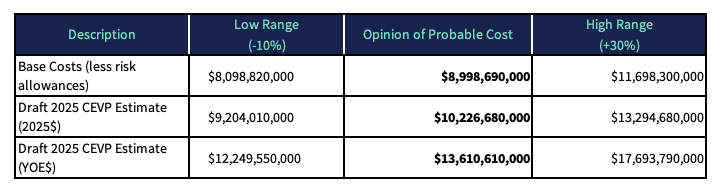
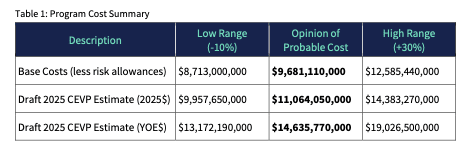
One table shows that range of cost estimates, the most likely cost (labeled “Opinion of Probable Cost”) and a high (+30%) and a low (-10 percent) estimate. This table shows the “Base Costs”–less any explicit adjustments for identified risk factors, the “Draft 2025 CEVP 2025$” (that estimate adjusted for the specific risks that IBR analyzed, expressed in current (2025) dollars, and the “Year of Expenditure” cost estimate–that 2025 figure adjusted for inflation between 2025 and the year in which expenditures would actually be expected to occur.
This table shows that the expected cost of the fixed span version project, in year of expenditure (YOE) dollars would be $13.6 billion, and would likely range between $12.2 billion and $17.7 billion.
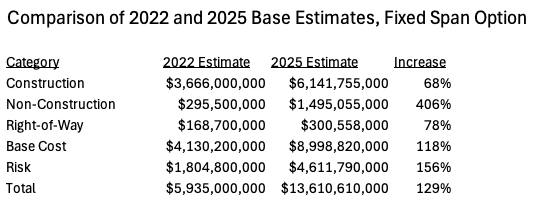
A second table compares this new 2025 fixed span estimate with the previous (2022) estimate. These figures are entirely in “year of expenditure” dollars, i.e. directly comparable to the last row on the table above. It is broken down by major category of expenditure (CN – construction, Non-CN – chiefly professional services, and ROW – Right of Way). These three categories make up the “base cost” estimate, which is then adjusted for the impact of identified risks.

The total expected cost of the project, in year of expenditure dollars, has more than doubled, from $5.9 billion in 2022, to $13.6 billion in 2025. The difference (delta) is an increase of nearly $7.7 billion.
What this means is that the estimator’s “most likely” estimate of project costs today $13.6 billion, is more $6 billion more than their 2022 estimate of the “highest” possible cost ($7.5 billion). The project’s expected maximum cost of $17.7 billion is now more than $10 billion more than the 2022 estimate of maximum cost.
Staff and consultant costs are the fastest increasing component of the new estimate
Overall, the total cost of the fixed span design has more than doubled, from about $6 billion to about $13.6 billion. But estimated construction costs have increased more slowly than overall costs. Construction costs are predicted to rise by about 68 percent over the earlier estimate. “Non-construction” costs–which are chiefly the costs for engineering consultants and staff time–are predicted to increase six times faster than actual construction costs, by 406 percent, compared to just 68 percent for construction. Higher non-construction costs constitute a $1.2 billion increase in total project costs.
The report confirms that the $1.2 billion increase is for staff and consultant expense and in part reflects the long duration of the project, which is now expected to continue for nearly 20 years, to 2045.
Non-Construction
• Extended program duration significantly increases labor and program management costs for both agency and consultant roles.
Work on the Interstate Bridge project is done overwhelmingly by consultants. A study of state highway procurement published by the Brookings Institution in 2024 concluded that reliance on consultants drives up costs, because consultants lack experience and have misaligned incentives.
. . . there is broad agreement that state DOTs have become more understaffed and that reliance on consultants drives up costs. Survey respondents attribute a lack of details in project plans to both a lack of time or experience of DOT engineers and the use of consultants. When there is not enough specificity in the plans the risk to the contractor increases, increasing bids. Moreover, whenever the scope of a project changes this initiates a costly and time-consuming renegotiation process. Survey respondents agree that such changes are a major contributor to costs. . . A lack of capacity at the DOT can hurt the quality of project plans, either from under-staffing in-house or from outsourcing to consultants with limited institutional knowledge and misaligned incentives.
Zachary Liscow, Will Nober and Cailin Slattery, Procurement and Infrastructure, July 11, 2024, Brookings Institution. (Emphasis added)
“Misaligned incentives” means that consultants have different incentives than the state agency hiring them. Consultants make more when the project is larger, takes longer, and is more expensive–all things that drive up costs. This is the classic “principal-agent” problem, and by delegating nearly the entire process of profit-motivated consultants, and failing to diligently and expertly supervise them, it is little surprise that the costs of this project has exploded.
Costs could go even higher
As alarmingly high as these new cost estimates are, the cost of the IBR may be even higher. This is the third in the series of cost estimates for the IBR; each successive cost estimate has exceeded the supposed maximum of the range of the previous set of estimates. The 2020 estimate said the maximum cost would be $4.8 billion–the 2022 estimate said the most likely cost would be $6.0 billion, and the maximum cost would be $7.5 billion; as noted this new estimate says most likely cost is well outside the range of the previous estimate (at $13.6 billion) and could reach $17.7 billion. Based on this pattern one would not be surprised to find a 2028 estimate predicting a cost of $20 billion or more. As we’ve frequently noted at City Observatory, the Oregon Department of Transportation has a two decade long track record of dramatically underestimating project costs and routinely experiencing 100 percent cost overruns.
Even the new estimates may be too low. In preparing these estimates, project staff were instructed to use the low end of unit costs (for inputs like concrete and steel) in preparing their estimates, which as the report notes, is not standard practice.

The fact that IBR cost estimates have been hidden or delayed for more than two years gives one little confidence in the process. In January 2024, City Observatory warned that the price of the Interstate Bridge Project could reach $9 billion. The Interstate Bridge Project has repeatedly delayed releasing a new cost estimate. As we wrote last month
The truth is that IBR project officials have a very, very good idea of the range of probable costs of both the fixed span and movable span options. The IBR has had a team of staff and consultants working on cost issues for years: this is an ongoing part of project planning, and not an episodic effort that only happens after one or two external bureaucratic hurdles are crossed. IBR, as their outgoing project director has said, is building “basically the same project” as the old Columbia River Crossing, and virtually none of the major features of the project have changed in the past three years. It’s also important to keep in mind that the cost estimate is not a single precise dollar amount; rather it is a wide range: the current estimate (produced three years ago) has a mid-point of $6 billion, with a range of costs running from $5 billion to $7.5 billion). It beggars belief that a project that has spent $273 million on consultants over the past seven years doesn’t have a pretty good idea within a billion dollars or so of what the current estimated cost of this project is (with an allowance for the added cost of a movable span option). The reality here is not that IBR doesn’t know about how much this will cost, it is that they really don’t want anybody else to know how much it will cost.
A $5 to $14 billion dollar funding gap
IBR’s financial plans have been based on the assumption that the project will cost between $5 and $7.5 billion. The much higher price creates a huge financial gap for the IBR. At the September 2025 meeting of the Joint Oregon and Washington Legislative Committees, IBR presented this financial plan:
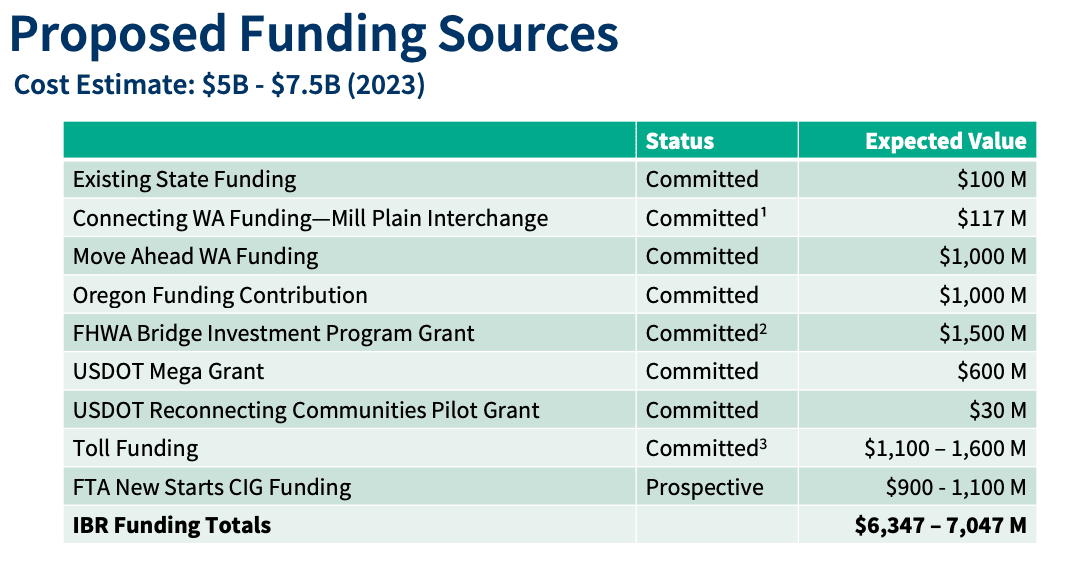
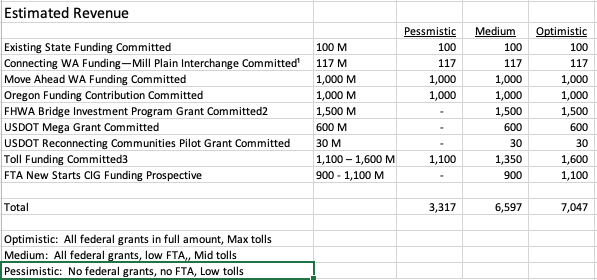
While IBR predicts that it may have as much as $7 billion in available revenue, that rests on a number of assumptions, in particular, that federal grants and toll revenues will be fully realized. While federal grants of more than $2.1 billion are labeled “committed” the bulk of these grant funds face a September 2026 deadline for the start of project construction, or they could be cancelled. A more pessimistic scenario could see those federal grants be rescinded, a transit grant fail to be awarded, and toll revenues come in at the lower range of estimates. This would mean that IBR would have only about $3.3 billion in available revenues. We present a range of possible revenue scenarios based on these alternatives, ranging from pessimistic to optimistic.
Combining the range of revenue estimates with the range of construction cost estimates shows the size of the financial gap that the program now faces. Under the most optimistic revenue scenario, $7 billion, and the new base cost estimate, $13.6 billion, the project faces a likely $6.5 billion funding gap. A more pessimistic, but entirely possible scenario, is that revenues fall to as little as $3.3 billion and costs balloon to as much as $17.7 billion, which would leave a $14.4 billion funding gap. Even under the most optimistic revenue and lowest current cost assumptions, the fixed span version of the project still faces a $5.2 billion funding gap.
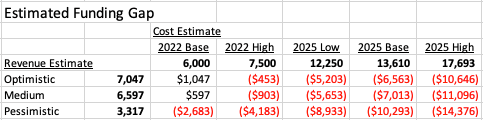
Oregon and Washington bear the entire financial risk of the project. It should be noted that the two states and not the federal government, bear the entire financial risk of cost overruns and revenue shortfalls. The federal government is legally able to rescind nearly all of the funding for the project in the event it fails to meet its September 30, 2026 construction start deadline. Tolling may produce only $1.1 billion. If the project were to proceed, Oregon and Washington would be fully responsible for paying all of these additional costs of the project. Oregon and Washington would be on the hook for paying at least $2.6 billion each, and potentially as much as $7.2 billion each.
A moveable span would cost even more
The estimates presented above are for a 116′ vertical clearance fixed span crossing. IBR also has estimated the cost of a movable span. IBR proposes to build a moveable span in the event that the US Coast Guard does not approve its request for a 116′ navigation clearance. A moveable span would cost considerably more than a fixed span. The “base”–most likely–estimate is that a moveable span would cost $14.6 billion (about $1.3 billion more than the fixed span) and could cost as much as $19 billion (again, about $1.3 billion more than the “high” estimate for a fixed span).
Whether the moveable span would cost as much more than a fixed span as shown here seems to be undetermined. IBR has two different estimates of the additional costs associated with the fixed span. One is part of the CEVP (shown above) and the other is the result of an independent “moveable span workshop”
IBR consultants at Parametrix summarized the decision to conduct two separate estimates of movable span costs on July 14
Key Notes: An independent evaluation of the movable span bridge is to be conducted, separate from the CEVP estimate.
Email; From: Ben Crawley RE: IBR Movable Span Estimate, July 14, 2025 at 3:03 PM PDT. To: Robert Turton
Elsewhere, IBR documents show there are alternate estimates showing in added cost of the moveable span would be between $100 and $300 million.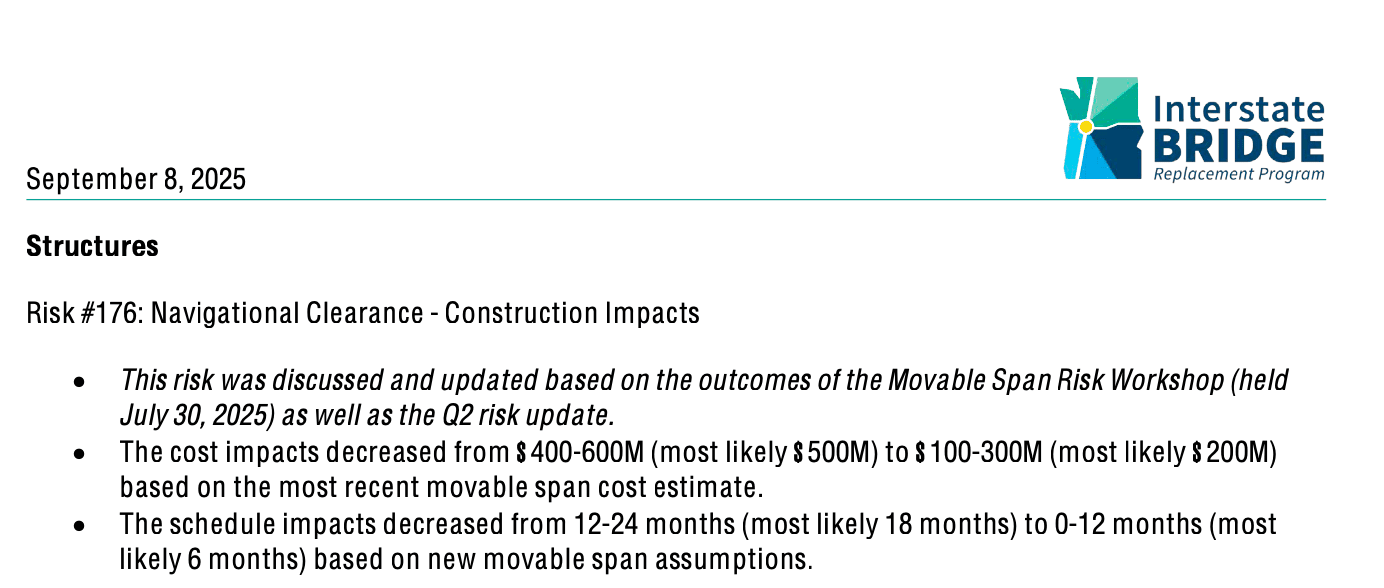
Source: Interstate Bridge Project, Q2 2025 Quarterly Risk Update, September 8, 2025
This estimate was the result of a special “Movable Span Risk Workshop” held on July 30, 2025. The new estimate reported that the most likely cost associated with a moveable span bridge would be $200 million additional, rather than the $500 million additional that IBR officials have repeated publicly.
Building a Moveable Span will take even longer
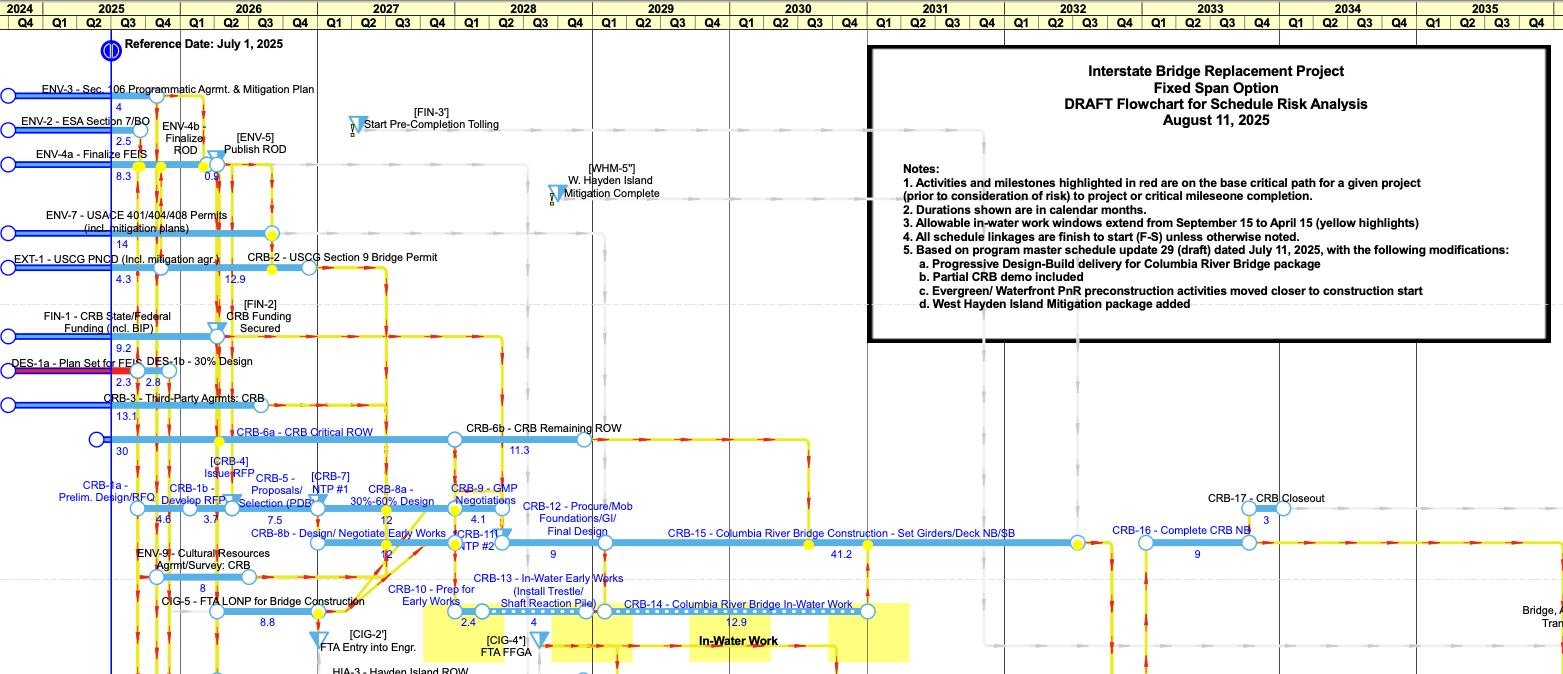
According to draft project schedules, it looks like a moveable span will take even longer to complete. A fixed span should be complete by the third quarter of 2033. (See item labeled CRB-16 “Complete CRB NB”)
A moveable span would take as much as an additional two years, until the third quarter of 2035.
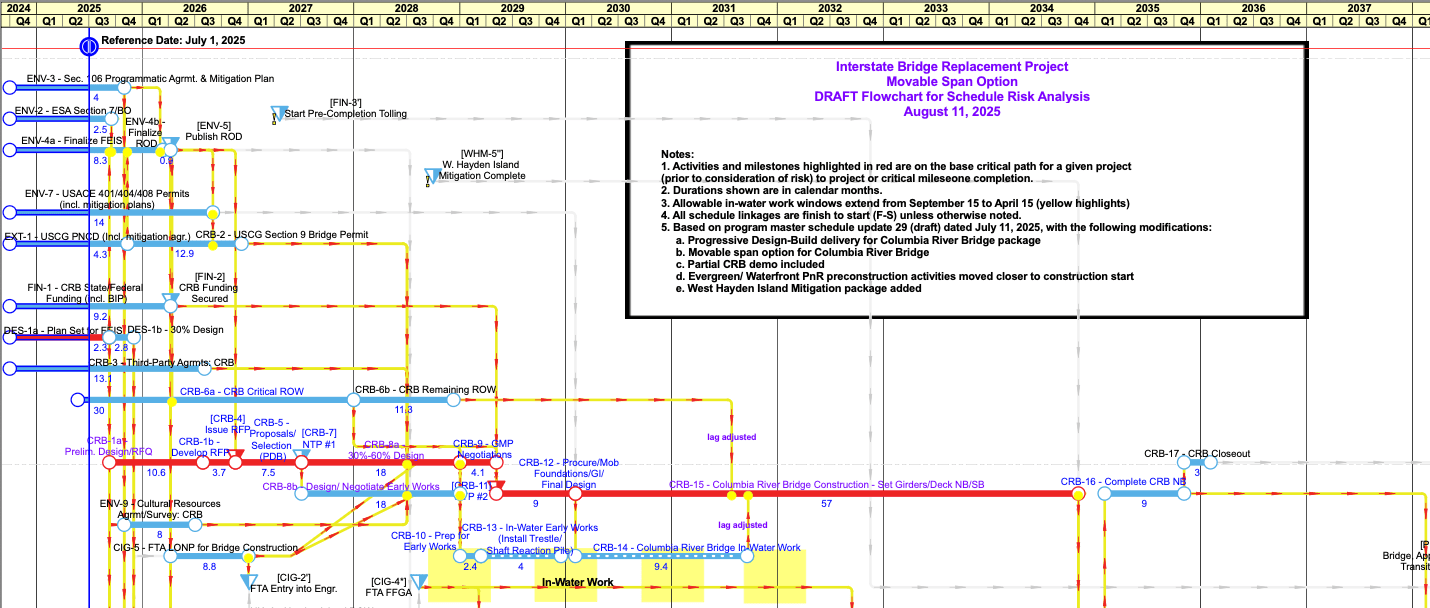
A key reason for the delay is that the moveable span will take additional time to design, and IBR will miss the scheduled In Water Work window that runs from September 2027 to April 2028; in-water work on a moveable span wouldn’t start until the In Water Work Window that begins in September 2028. These In-Water Work Windows are shaded yellow in the project timeline. (Construction of the new bridges is expected to take four seven-month long in-water work windows).
Fixed Span Base Costs by Package and Major Category
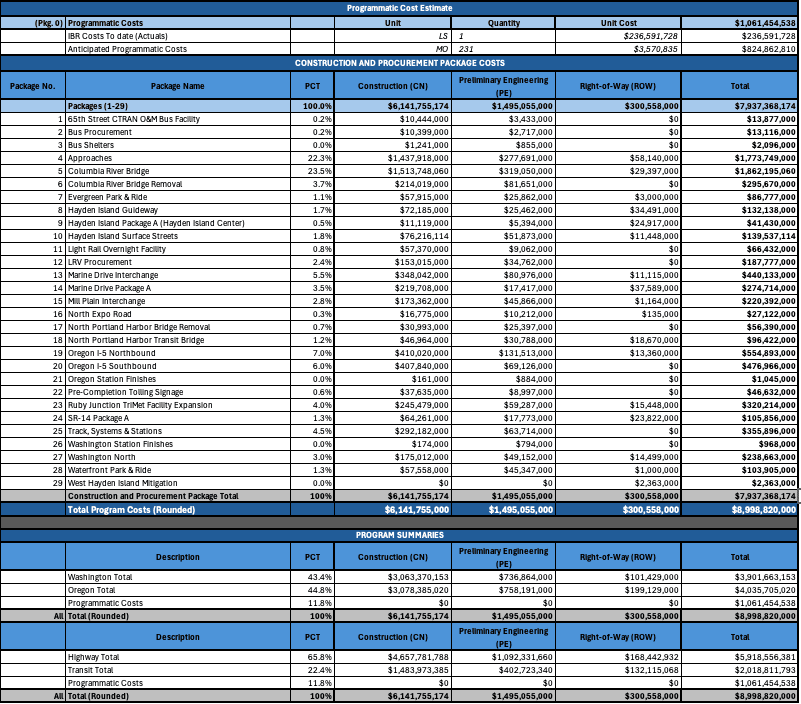
It’s important to know that while the estimates obtained from IBR are labeled “Draft” they are not rough or partial work products. The cost estimates presented in these spreadsheets are extremely detailed. For example, the following table summarizes the cost estimates for each of the 29 proposed construction packages, broken into three categories of cost (construction, engineering, and right-of-way). The table also shows the division of costs by state, and the proportions allocated to the highway and transit portions of the project. (Each of the 29 packages also has a separate supporting spreadsheet showing the basis of that estimate). All of this work is subject to revision and adjustment in the “Cost Estimate Validation Process” or CEVP, but is unlikely to change significantly from the values shown here, and the “most probable value” is certainly going to be within the range ($12.25 billion to $17.7 billion) shown in these estimates.
Note: This commentary has been revised to correct an error in the date on which construction must begin to maintain federal grant funding eligibility.
Source: https://cityobservatory.org/17-7-billion-exploding-costs-doom-i-5-bridge-replacement/