JAN 23, 2026 ANALYSIS: IBR’S SYSTEMATIC DISINFORMATION CAMPAIGN, ITS DEMISE, AND A PRACTICAL COST-EFFECTIVE SOLUTION FOR THE I-5 CROSSING THAT’LL SAVE $ BILLIONS!

February 11, 2026 | Download Article
As our organization’s name, “Neighbors For A Better Crossing,” suggests, we are 100% for a new I-5 crossing to solve traffic congestion at the Columbia River, but definitely 100% against the Interstate Bridge Replacement (IBR) Program’s mega bridge, a failed concept from its predecessor, the Columbia River Crossing (CRC) project. Our group includes transportation experts & civil engineers, past & present state government officials, neighborhood organizations, and residents along its path who have been documenting IBR’s systematic disinformation campaign and efforts to block testimony about practical, cost-effective alternative to IBR’s mega bridge. We take no solace in seeing the demise of the IBR and the $ millions of taxpayer dollars lost, as we still need to solve traffic congestion at the crossing. The following documents our findings, and includes a practical cost-effective solution that will solve traffic congestion at the crossing.
IBR’S MEGA BRIDGE PROJECT DEMISE
The Interstate Bridge Replacement (IBR) “mega bridge” project will forever be remembered as one of the most costly, mismanaged, and misrepresented transportation projects in the history of the Pacific NW. Its failure has resulted in the loss of $300 million of taxpayer money in addition to the $200 million lost by its predecessor, the Columbia River Crossing (CRC) project. From its beginning, the IBR engaged in a systematic disinformation campaign crafted to mislead the public into a false belief our historic Interstate Bridge was seismically unsafe. It conducted a continuous “seismic scam” about the Interstate Bridge’s resilience to earthquakes, and we have proof. Origins of the scam need to be investigated as “the fix was in” from the start for a very large & expensive bridge, rather than a practical, cost-effective solution to solve traffic congestion at the crossing. IBR blocked attempts to seriously consider other options than their MOAB (Mother of All Bridges) bridge design that amazingly will not solve traffic congestion at the I-5 crossing. From its inception, the IBR was less about quality engineering and far more about forcing a failed mega bridge design on taxpayers, and we need to know why.
RESIDENTS AND BUSINESSES SHOULD BE RELIEVED
Residents & businesses on both sides of the Columbia River have reason to be relieved as the IBR project would’ve taken 15+ years to build, imposed burdensome tolls & financial hardship on residents & businesses, massive bond indebtedness on taxpayers, mass expropriation of 43-76 residential units, 36-39 businesses, 35 floating homes, 1 public use site, major fish & marine life kill on the Columbia due to 5 years of high impact drilling for bridge supports, $ millions in expense to retrofit commercial vessels to fit under IBR’s bridge with 62ft less navigation clearance, 90ft high transit stations and steep half-mile long pedestrian ramps, and the totally unjustified demolition of our historic Interstate Bridge which the IBR intends to give away for scrap!
AT AN ESTIMATED OVERALL PROJECT COST OF $17.7 BILLION, IBR’S MEGA BRIDGE HAS BECOME A BRIDGE TOO FAR
On January 8th, Bike Oregon published an interview with noted economist Joe Cortright, who shared information obtained through a Public Records Request that revealed the actual cost of IBR’s fixed-span bridge project would be about $17.7 Billion. It also proved that the IBR and its consultant, WSP USA (a division of Canada-based WSP Global), knew about the cost overrun for months and lied about it. Even with this disclosure, the IBR & WSP project staff continues to spend money at an excessive rate as if it’s still alive. The IBR’s I-5 Bridge project is now completely unaffordable and effectively dead.
On January 7th, The Willamette Week reported Interstate Bridge Staff Hid Information About Ballooning Cost of Giant Highway Project, as the estimated price tag of the Interstate Bridge Replacement (IBR) project had more than doubled from $6 billion to $13.6 billion. The IBR staff told a Bi-State Panel on Dec 15 it didn’t have new numbers, but documents obtained by the Oregon Journalism Project show IBR staff’s claim it couldn’t provide new cost estimates, was a lie. In fact, IBR’s lead consultant (WSP) had completed highly detailed, updated cost estimates for the project by Aug. 15 – four full months before the December meeting. That rang alarm bells, warning of project mismanagement and lack of transparency!
The IBR project began with a failed bridge design developed by the Columbia River Crossing (CRC), which began in 2005 and failed in 2013. ODOT & WASDOT relaunched the failed CRC project in 2020, and renamed it the “Interstate Bridge Replacement (IBR) Program.” Last November, Joe Cortright asked, “Why has the IBR spent $273 million on consultants for basically the same project as the failed CRC project? Our group has been asking the same question.
A FULL AUDIT AND INVESTIGATION OF THE IBR IS NOW REQUIRED
With the demise of the IBR, a full investigation must now be conducted. Full accountability is needed for taxpayers in both states. On Jan 26th, WA Rep. John Ley introduced a new bill calling for an independent audit of Interstate 5 Bridge Replacement Project. We ask all Washington & Oregon taxpayers & legislators to fully support a compete audit of the IBR. Who were the public officials behind the initial decision to press for a mega bridge?
What role did IBR’s lead bridge consultant WSP play in the decision? Investigators also need to look into IBR’s award of a consulting contract to WSP for $44 million with a 32% profit guarantee, and without competitive bidding. In July 2020, IBR’s Greg Johnson was appointed to lead the IBR, he was formerly a Vice President of WSP in Michigan. Two months after his appointment, Greg awarded his former employer (WSP) a $44 million 5-year contract that guaranteed WSP an outrages 32% profit… but there were no other bidders of record.
WHY THE IBR MEGA BRIDGE PROJECT FAILED
- IBR’S DISINFORMATION CAMPAIGN & ITS “SEISMIC SCAM” STARTED WITH THE SELECTION OF ITS NAME
While its $17.7 Billion price tag effectively killed IBR’s mega bridge project, the reasons for IBR’s demise date back to its formation. As its name, “Interstate Bridge Replacement,” implies , the historic Interstate Bridge needed to be replaced, but that was false as there’s no current seismic evaluation of the I-5 bridge to support that claim. In its Executive Summary, a 2006 CRC Panel Assessment of the Interstate Bridge’s Seismic Vulnerabilities study confirmed that it was feasible to continue retrofitting the existing Interstate Bridge to current seismic safety standards. That 2006 study is the latest I-5 bridge assessment on record. IBR was aware of the 2006 seismic assessment from the beginning, as several former CRC members were on its staff and involved in it. Nevertheless, the IBR continued with its “seismic scam” that the Interstate Bridge was seismically unsafe.As part of its systematic disinformation campaign to discredit the strength of the Interstate Bridge, the IBR circulated an animated video in 2021 that could have been about any bridge, including IBR’s mega bridge. It shows the Interstate Bridge collapsing during an earthquake… it was pure propaganda. All of their statements and actions from the beginning have been aimed at scaring the public into believing the existing bridge needed to be replaced as soon as possible. When our group challenged the IBR and called for a current seismic study of the Interstate Bridge to support their claim that the I-5 Bridge would not meet seismic standards, the IBR didn’t respond.in 2022, the IBR received $ 1 million from the Federal Highway Administration to study the bridge’s seismic and geotechnical conditions. Despite this, neither WSDOT nor ODOT released any current seismic assessment of the Interstate Bridge. If there was a current seismic study, why hasn’t the IBR released the findings to the public? If there wasn’t a study, what happened to the $ 1 million federal grant? Residents and visitors to the Pacific NW who love & admire our historic bridges should be outraged that the IBR was willing to destroy an icon of NW history without a current seismic study.
The IBR repeatedly exaggerated the earthquake risk of our historic I-5 Bridge’s wooden “Clustered Log Pilings” when in fact, a 2014 JSCE study proves the tightly spaced group of ninety (90) 120ft long wood pilings in each of the 9-piers (a total of 810 pilings) supporting our bridge are a “fail-safe” protection against earthquake-generated soil liquefaction. Our historic bridge may be better protected against earthquake damage than a mega bridge, since bundled wooden log pilings flex while rigid steel supports don’t. Wooden log pilings remain strong indefinitely as water acts as a preservative, which is why submerged logs in lakes & rivers can last for centuries.
- IBR’S CRITICAL MISTAKE
IBR’s critical mistake was in reintroducing a failed CRC bridge proposal and failing to listen to traffic experts and engineers outside IBR’s inner circle. The arrogance of IBR’s Greg Johnson in minimizing public discussion was telling. The IBR pushed a failed bridge design with little consideration for residents & businesses along its path. IBR’s tactics to force a failed bridge design on taxpayers, contributed to its own demise. - IBR’S BRIDGE DESIGN FAILURE
A critical design flaw in IBR’s three bridge designs is that none would have solved traffic congestion at the I-5 crossing, which was IBR’s primary objective. Each bridge plan shows only 4 lanes of traffic (in each direction). To assess whether their designs would work, all the IBR had to do was look upstream to the Glenn Jackson Bridge (which also has 4 lanes in each direction). With similar traffic counts, the Glenn Jackson Bridge experiences heavy traffic congestion each morning & afternoon. According to transportation experts, IBR’s designs should have provided at least 5-6 lanes (each direction) to address traffic congestion at the I-5 crossing, especially given the on/off ramps at Hayden Island that slow traffic flow. - INSUFFICIENT VERTICAL NAVIAGATIONAL CLEARANCE FOR COMMERCIAL CRAFT ON THE COLUMBIA
Notwithstanding the action of both OR & WA Governors to pressure the US Coast Guard to accept a 62ft lower marine navigational clearance of IBR’s fixed bridge, anything less than the 178ft clearance currently provided by the existing I-5 bridge is an extremely bad idea. With IBR’s bridge at only 116ft clearance (62ft less than the existing Interstate Bridge), a large number of the commercial vessels serving Eastern OR & WA will be required to retrofit in order to pass under IBR’s fixed bridge, costing those commercial operators $ millions. It should also be noted that the tallest ship currently using the Interstate drawbridge is the USS Yaquina service vessel used for dredging. The Yaquina needs 115ft of vertical clearance, but IBR’s bridge offers only 116ft, leaving 1 ft of vessel clearance. River height is generally maintained at 43ft, but can reach 75ft or higher. No wonder the US Coast Guard is concerned! - IBR’S RECENT “REVISED” RIDERSHIP ESTIMATE KILLED TRIMET’S LIGHT RAIL EXPANSION TO VANCOUVER!
The IBR misled the public for years by claiming that TriMet’s Light Rail expansion from Delta Park to Vancouver would be fully supported by carrying 18,700 passengers per day. In October 2025, the IBR was forced to use a USDOT metric that put the estimated ridership at only 5,000 passengers per day, which doesn’t justify any light rail expansion to Vancouver. At only 5000 passengers per day, a modest increase in TriMet bus service can easily accommodate that number. Last May, WA Rep. John Ley warned that TriMet was seeking $190M-$290M For Interstate Bridge Light Rail Vehicles “Charging Taxpayers $15M Per Vehicle…”Triple Its $4.5M Cost.” - IBR’S “TIME BOMB” OF UNKNOWN COSTS OF HIGH IMPACT DRILLING OF 96 (10FT DIAMETER) DRILLSHAFTS
IBR’s plan is to install 1,775 temporary 24-inch and 48-inch in-river piles to support a giant oscillating machine as it attempts to sink 96 in-river 10ft diameter shafts 250ft deep in the riverbed over 5 years of high-impact drilling. On Nov 25, 2025, Civil Engineer Bob Ortblad reported that IBR hid its critically important geotechnical report from its Supplemental Environmental Impact Statement (EIS), which addressed major unknown costs related to drilling issues raised in a previous Malcolm Drilling report recounting its failure to sink a test shaft due to boulders at the I-5 crossing.Malcolm’s test drill was commissioned by the Columbia River Crossing (CRC) in 2012, which spent $4.2 million to test a few piles and a single shaft. Malcolm Drilling Co tried to sink a single 10ft diameter steel casing down 250 feet on Hayden Island but encountered boulders 106 times and cobbles 175 times in a 200-foot layer of sediment. The IBR is very aware of that report, and yet they omitted any mention of it from their draft supplemental EIS. That omission represents a “time bomb” of unknown costs for those 96 drill shafts. Ortblad points out that, in comparing drill shaft costs at the Hood River & Abernathy bridges, the unknown cost of drilling IBR’s 96 drill shafts could far exceed $8 million as rock boulders are encountered at the I-5 crossing. Malcolm Drilling’s “boulder” problem is now IBR’s “boulder “problem— those very large boulders deep into the riverbed that could make drilling for bridge supports cost-prohibitive. - THE IBR BLOCKED AN ALTERNATIVE TO ITS MEGA BRIDGE THAT WOULD’VE MADE IT A SUCCESS
A more cost-effective alternative to a bridge is an Immersed Tube Tunnel (ITT). It’s not a “bored” tunnel that’s constructed with a massive cylindrical Boring Machine (TBM). An ITT is constructed in “modules” on land, barged into position, lowered in a trench that’s been dredged in the riverbed. Its modules are then linked together and covered with backfill materials to lock them into place. The modules are covered with “locking fill” of gravel or rock, followed by a thick layer of armor stone or the original dredged material 5ft thick. If traffic lanes are needed in the future, a row of modules can be added adjacent to the first row. An ITT doesn’t require bridge supports, so it avoids IBR’s “time bomb” of unknown expense of high-impact drilling of IBR’s bridge-support shafts. An ITT is also more earthquake resilient as it flexes with the ground during a quake.IBR’s Greg Johnson took repeated steps to block testimony from ITT experts on the advantages of a lower-cost ITT as an alternative to IBR’s fixed-span bridge. On March 1, 2021, the IBR published a Tunnel Concept Assessment that it then used to disqualify an immersed tube tunnel as a viable alternative to a bridge. Greg Johnson briefed officials that it wasn’t feasible to connect an ITT to SR-14, however a leading transportation expert in our group has identified a cost effective solution. Curiously, IBR’s assessment went unsigned & uncertified by a licensed engineer for 2 years, until a civil engineer in our group kept pressing them to correct that omission. On April 19, 2023, the IBR issued Rev#2 Tunnel Concept Assessment, signed by engineer Robert Davis Turton, Senior Vice President of WSP. However, a review of Turton’s LinkedIn profile shows he has no tunnel experience.When Rev 2 was reviewed by our transportation and engineering experts, several major miscalculations and discrepancies were identified in the assessment design approach, raising suspicions that IBR’s Tunnel Concept Assessment was intended to disqualify the ITT option. Investigators need to determine whether Robert Turton was even qualified to sign the assessment.
- IBR’S LACK OF TRANSPARENCY
For most of his tenure, IBR’s Greg Johnson claimed the IBR was fully transparent, but there’s little evidence to support that. As we now know, the IBR was neither honest nor transparent about the rising cost of their project to the Bi-State Panel. When our organization filed a Public Information Request for elevation views of its mega-bridge design along the project path, the IBR denied the request. The lack of side views has left residents along its path without any idea of what the bridge would look like in their neighborhoods. The IBR was mandated to seek public comments, e.g., the pending destruction of the Interstate Bridge (mandated by the National Historic Preservation Act) and the mass fish kill & loss of marine life to 5 years of high-impact drilling of IBR’s bridge supports (mandated by the National Marine Fisheries Service). Why weren’t the results of those public comment periods publicly released? - STRONG PUBLIC RESISTANCE TO TOLLS & HIKES IN TRANSPORTATION TAXES?
As evidenced by the successful petition drive for the No Tax Oregon Initiative and support for the Vote Before Tolls Initiative, there’s now a major public backlash against tolls & excessive transportation tax increases. It’s easy to see why, as state transportation agencies have a track record of letting road improvement projects grow out of control, resulting in huge cost overruns and project delays. That’s what happened with IBR’s mega-bridge project. Oregon’s Abernathy Bridge Project is yet another example of a project currently experiencing significant cost overruns.As for tolls at the I-5 crossing, it’s important to note that there are no toll stations on I-5 between the Mexican and Canadian borders. Tolls on such a vital highway are to be avoided as they impose a heavy financial burden on everyone using the crossing. That’s especially true at the I-5 crossing, when the public has repeatedly opposed tolls at both the I-5 and the Glenn Jackson I-205 crossings.State transportation departments are expected to be fully accountable to taxpayers for their projects. They are expected to provide accurate project estimates and project oversight to minimize cost overruns & delays. Any state agency (IBR) and its lead consultant (WSP) that attempt to hide a cost overrun of $11.7 billion on a project initially estimated at $6 billion, requires investigation and termination.
A PRACTICAL & COST-EFFECTIVE SOLUTION FOR SOLVING TRAFFIC CONGESTION AT THE I-5 CROSSING
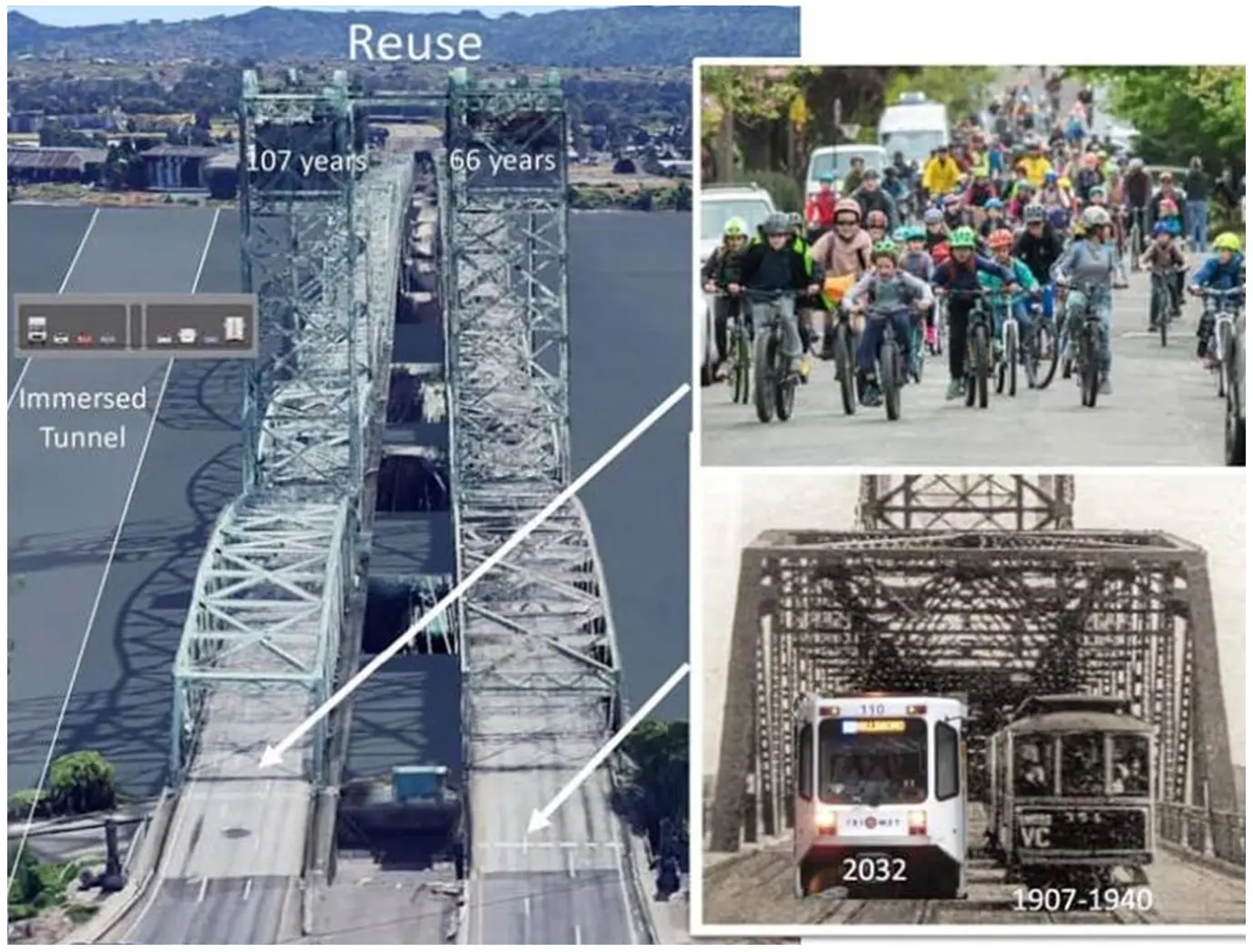
According to leading transportation and engineering experts in our group, there’s a far more practical and less costly solution to solving traffic congestion on I-5 at the crossing, and that is to build a 4-lane (each direction) “EXPRESSWAY” between Delta Park and Vancouver without on/off ramps at Hayden Island to impede traffic flow. That can be done by repurposing the existing Interstate Bridge for local traffic between Vancouver and Hayden Island. A new crossing at I-5 could be either an immersed tube tunnel (ITT) or a 2nd bridge. A repurposed Interstate Bridge then becomes a major part of a solution that will save $ billions and solve traffic congestion at the crossing.
The Fraser River crossing in Vancouver, BC, is very similar to our own crossing. An ITT is being built over the Fraser River without tolls, at a cost of $3 billion USD. ITTs are less expensive and take less time to build than bridges, and they don’t require bridge supports, so IBR’s financial “time bomb” related to its 96 drill shafts is avoided. In combination with a repurposed Interstate Bridge, an ITT allows commercial vessels to retain the full 178ft of vertical navigational clearance, avoiding $ millions in retrofit costs for their marine craft. Our crossing is in the Cascadia Subduction Zone, where a major earthquake is a distinct possibility. ITTs are also seismically resilient and are used in seismically active regions like Japan and San Francisco. ITTs offer a seismic advantage over a tall bridge as an ITT flexes with the ground during an earthquake, whereas tall steel bridge supports that are locked into position can fracture & collapse.
As for any future Light Rail extension, ITTs are used for subway, metro, and light rail systems. An example is a 3.6-mile immersed tube tunnel is Bay Area Rapid Transit (BART), which runs under San Francisco Bay. An expansion of light rail to Vancouver can be included in the ITT’s original design or by adding additional ITT modules later. Repurposing the I-5 bridge also provides an additional option for Light Rail as several vehicle lanes on the Interstate Bridge can be repurposed for Light Rail. A repurposed Interstate Bridge also allows bike & pedestrian traffic to cross the Columbia without a steep 90ft climb to reach IBR’s mega bridge.
SUMMARY
The beauty of our historic Interstate Bridge continues to enhance the beauty of the I-5 crossing, and both work in concert to generated a uniquely beautiful crossing. Both need to be protected! The combination of an immersed tube tunnel and a repurposed historic bridge is a practical and cost-effective solution for protecting both, while solving traffic congestion at the crossing. While tolls are often considered for state highways, they are rarely considered for interstate freeways unless there’s no other option. A cost effective option exists for avoiding tolls at our Interstate 5 crossing!
Despite IBR’s spurious claims, the Interstate Bridge is strong and will remain strong indefinitely with periodic seismic upgrades as mandated for all WA & OR bridges. The National Bridge Inventory (NBI) data shows that as of 2025, there are 262 road bridges in OR & WA that are older than the Interstate Bridge. Oregon has 85, and Washington has 177, all of which are in daily use with years of service remaining.
It’s time for an independent commission of impartial industry experts, to seriously consider the “ITT and Interstate Bridge” combination as a practical solution for the crossing. It will save $ billions. I invite transportation officials and state legislators to meet with our group of transportation experts, civil engineers, and others to discuss the solution outlined above, as we still need an affordable solution for the I-5 crossing that fully protects that scenic beauty of the I-5 crossing, potentially without tolls
Respectfully,
IBRs-Disinformation-Campaign-and-Demise
Gary Clark, Chair
Neighbors For A Better Crossing, Inc
Cell: 503.703.9749
Email: gary@neighbors4a-bettercrossing.org